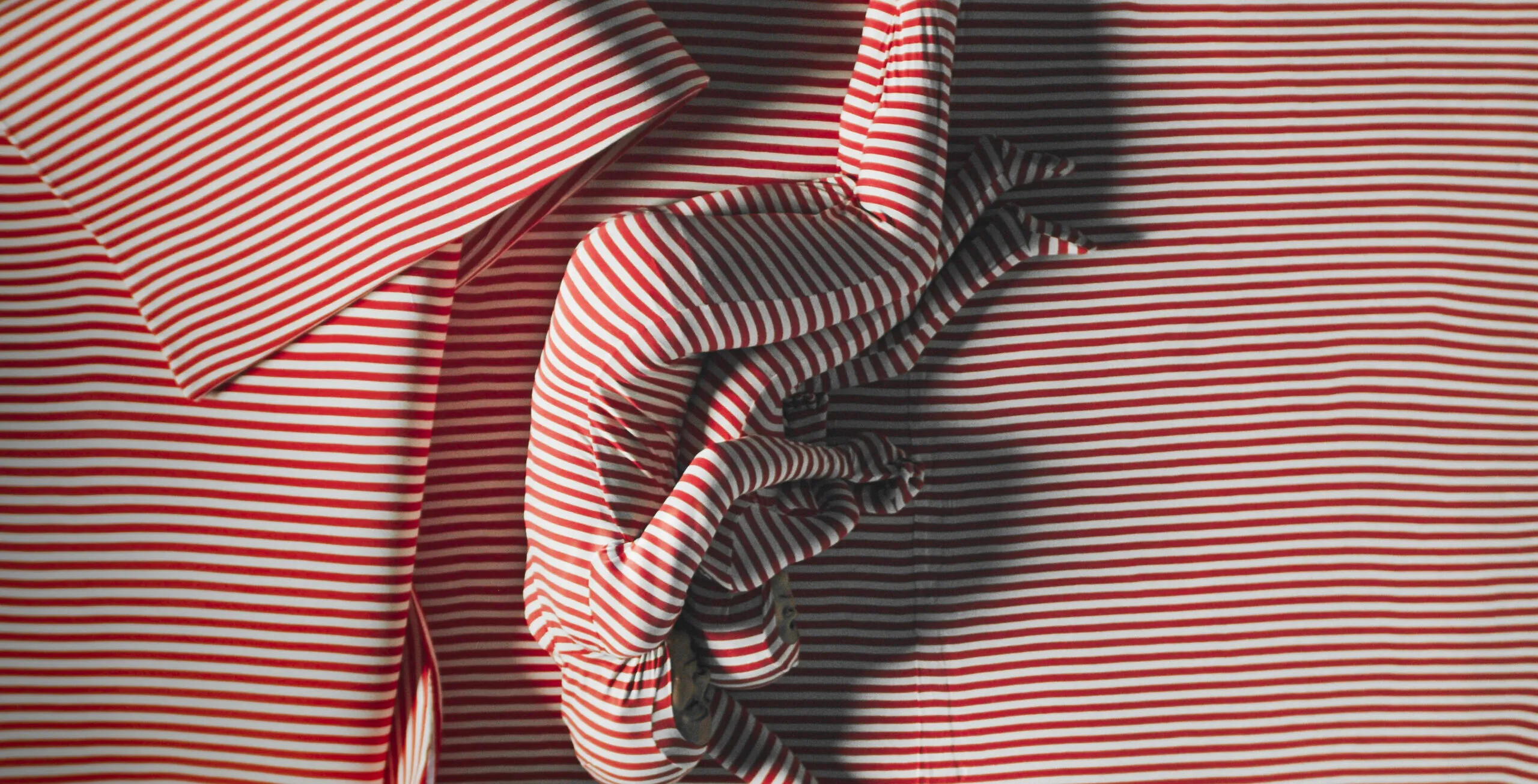
MOTHERGROUND presents the work of Franco‑Manitoban artist Dominique Rey and offers one of Canada’s first sustained reflections on the complexity of motherhood.
Created in collaboration with Rey’s children, Madeleine and Auguste Coar, the exhibition unfolds in three thematic chapters. Each chapter reveals a different period in the artist’s ongoing study of the emotional terrain and cultural expectations that shape maternal experience. Through photographs, photo‑collages, human‑scale sculptures, and video installations, the exhibition surrounds us with scenes that evoke both the intimacy and universality of motherhood.
Rey approaches artistic practice, fertility, and maternity as intertwined forms of creative labour, together examining how ordinary gestures between mother and child can carry profound meaning. MOTHERGROUND considers the many transformations that accompany early motherhood: the shift between balance and imbalance, and the movement between intense emotional states that define this stage of life.
Rey’s works focus on moments when the bodies of mother and child come together and pull apart, continually reshaping their relationship. In these images, the mother’s body becomes ground, soil, and structure—a physical and symbolic foundation for the child’s growth. Together, the artworks explore presence and absence, attachment and desire, and the blurred boundaries, both physical and emotional, that bind mother and child.
MOTHERGROUND is curated by Dr. Riva Symko, Head of Collections & Exhibitions at WAG-Qaumajuq in Winnipeg, Manitoba.
About the artist:
Dominique Rey is a multidisciplinary artist whose practice includes photography, video, performance, collage, and sculpture. Her work delves into peripheral subjectivities, from individuals and groups of people on the margins of dominant culture, to performance-based works that mine the unconscious. She is interested in examining the outsider within society, as well as a deep sense we have of being strangers to ourselves. For this reason, Rey utilizes modes of fragmentation to explore the construction of the self, as it relates to experiences of dislocation and disorientation. Throughout her work there is, as curator Sandra Fraser notes, “the tension of being outside one’s own desires, a palpable absence of certainty and longing for connection–both from within and without.”
Rey’s recent work focuses on practices of recontextualization and translation. Collages derived from her photographic archives that are then re-interpreted into large-scale sculptures that she considers “photographic objects.” She is interested in pushing the boundaries between photography and sculpture, reinvigorating ideas of surface, materiality, and illusion.
This exhibition is organized and circulated by WAG Qaumajuq, with support from the Canada Council for the Arts


Stay Connected
Sign up for our newsletter and be the first to hear about our exhibitions, events and public programs!