
The Collection
At Museum London, art, history, and contemporary culture meet in meaningful and inspiring ways. Home to more than 5,500 artworks and nearly 50,000 historical artifacts, our collection highlights the creativity and stories of London and Southwestern Ontario—from powerful paintings and photography to objects that reflect the city’s rich social, industrial, and cultural history.
Featured Artworks & Artifacts

Nativity Scene, 2017
Kent Monkman
Installation
Purchased with funds from the Volunteer Committee Acquisition Fund (1956-2017) in memory of Shelagh Martin-McLaren, 2017
Why we chose this
In Nativity Scene, artist Kent Monkman imagines the birth of his alter ego, Miss Chief, who appears in many of his paintings, videos, installations, and performances. Here, he uses familiar and evocative objects like a Coca-Cola bottle, a Hudson’s Bay blanket, and draws on symbols from popular culture, sports, and Christianity to disrupt colonial narratives. His work opens up conversations about the harmful legacy of residential schools, inequality, representation, and re-frames Indigenous presence at the centre of history. This work was part of Monkman’s 2019 solo exhibition, Shame and Prejudice: A Story of Resilience at Museum London.

401 Towards London No. 2 (unfinished), 1968
Jack Chambers
oil on wood
Purchase, John H. and Elizabeth Moore Acquisition Fund, 2026
Photo Credit: Alex Walker
Why we chose this
Jack Chambers remains one of London’s best known 20th century artists. 401 Towards London No. 2 is the unfinished companion to the first version, now at the Art Gallery of Ontario, in which an expansive view of southwestern Ontario landscape plays backdrop to a full cast of vehicles, signage, and serpentine asphalt. In this painting, we’re a little further down the road, the overpass that provided the first’s elevated perspective squarely in our rear-view.
While the sky reveals Chamber’s telltale care, the landscape is roughly rendered, the details of the urban fabric absent. Begun in 1968, it is not entirely clear why Chambers left No. 2 incomplete. Regardless, it offers a rare peak at the process beneath his famously airtight realism.
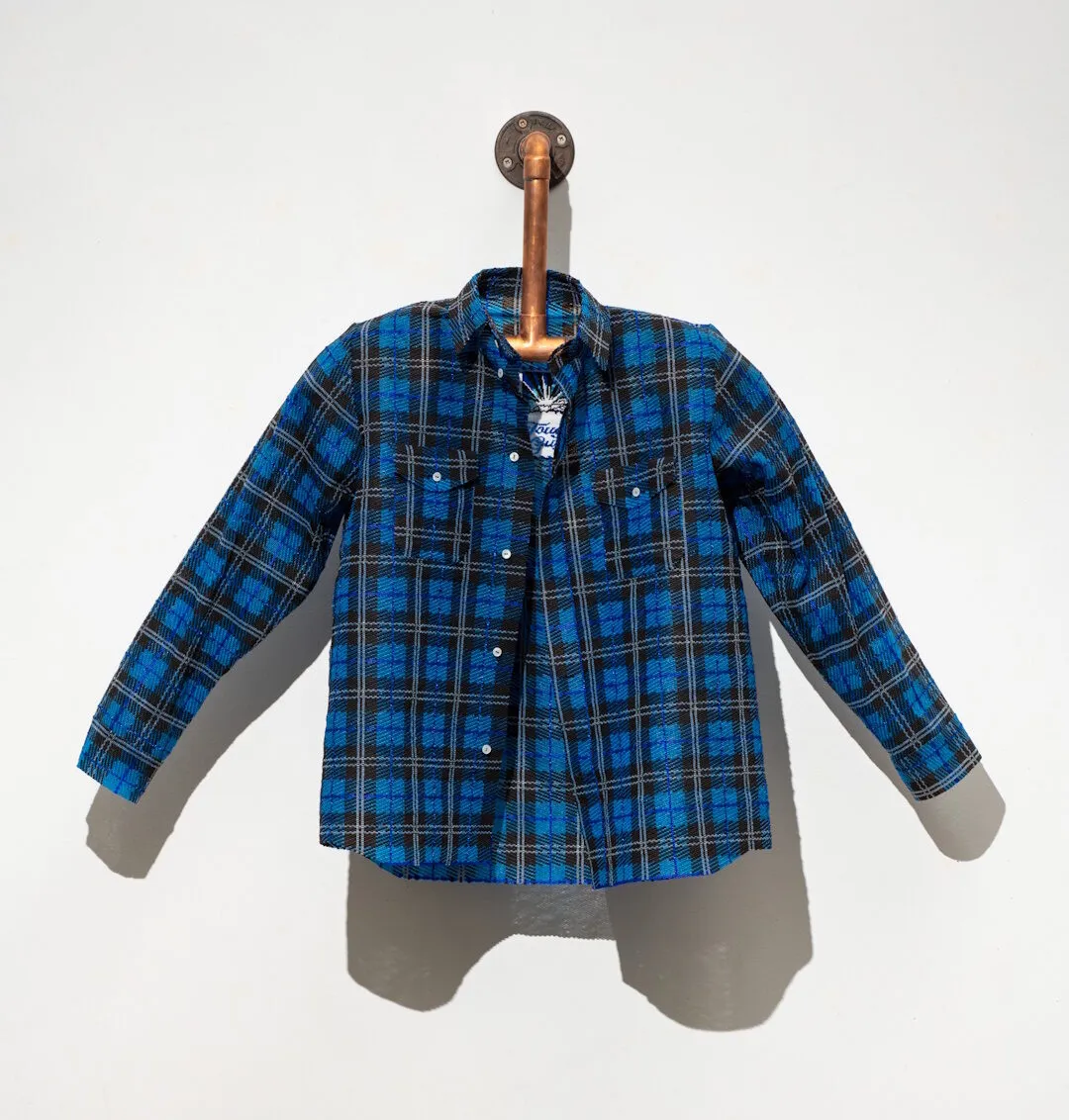
Tribute to a Warrior (Dudley George), 2026
Nico Williams
10/0 Japanese glass cylinder beads and 11/0 seed beads on thermally-fused/braided polyethylene thread
Purchased with funds from the Volunteer Committee Acquisition Fund and the support of the York Wilson Endowment Award, administered by the Canada Council for the Arts, 2026
Photo Credit: Paul Litherland
Why we chose this
Tribute to a Warrior is a life-size beaded recreation of Canada’s ubiquitous blue and black plaid flannel jacket. ML commissioned this work as a key expression of Williams’ practice, which considers everyday experience and the presentation of Indigenous identity and history. It importantly also symbolizes the controversial 1995 Ipperwash Crisis, a landmark in the ongoing legacy of colonialism in our region.
Indigenous protesters occupied Ipperwash Provincial Park to dispute the Canadian government’s longstanding occupation of their land. On the night of Sept. 6, OPP officers confronted people near the park. Dudley George, an unarmed Anishinaabe man from the Stoney Point community of the Chippewas of Kettle and Stoney Point First Nation, was shot by an officer and died the next day. The empty jacket evokes the loss of a human life, colonial displacement and violence, and serves to keep memory alive.

Lady’s Brown Suit with Three-Quarter Length Sleeves, circa 1950s
Stuart Kent Harper
Gift of Gwen Zezulka, Toronto, Ontario, 2025
Photo Credit: Alex Walker
Why we chose this
Designer Stuart Kent Harper made this suit for his wife, Phyllis, in the 1950s. Born in Malahide Township, Ontario, in 1907, Harper graduated from Queen’s University. After a course at the New York School of Fine and Applied Art, he entered the design world in Paris where he did a year of research and freelance work. Harper then returned to New York and opened a shop. Following service overseas with the American Forces in the Second World
Image & Resource Requests

Stay connected
Sign up for our newsletter and be the first to hear about our exhibitions, events and public programs!